Kongad voter sentiment analysis 2026 highlights a stable and predictable electoral scenario as Kerala approaches the Legislative Assembly Elections. The constituency is emerging as a stronghold for the Left Democratic Front (LDF), with consistent voter alignment across perception metrics and projected vote share.
Semiotica.ai’s latest analysis shows that Kongad is not just leaning toward LDF but demonstrating clear consolidation, making it one of the most stable constituencies in the current electoral landscape.
Kongad: A Stable LDF Stronghold
Kongad reflects a high-confidence constituency where voter perception and electoral intent strongly align in favor of LDF. The kongad voter sentiment analysis 2026 indicates minimal volatility, with a structured and consistent preference pattern.
Unlike competitive constituencies, Kongad shows clear dominance by one alliance, reinforced across multiple voter perception dimensions.
Alliance Positioning: LDF Dominates Across Metrics
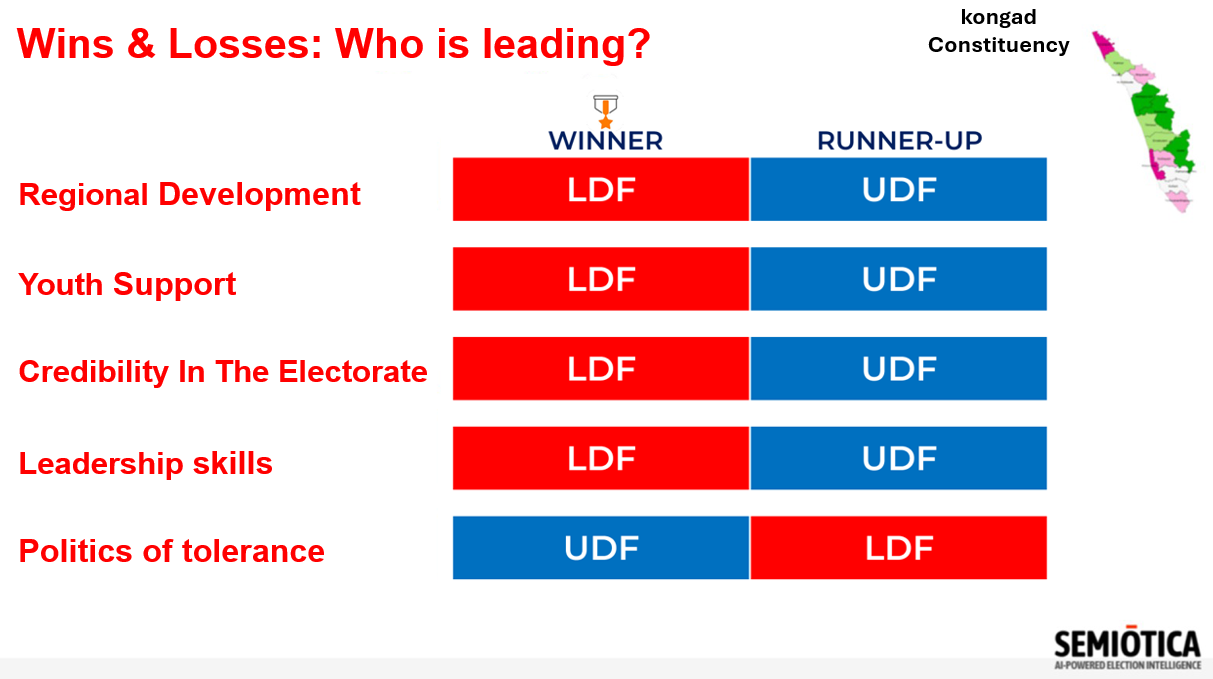
Semiotica’s AI-driven insights reveal a strong LDF advantage across most key voter perception areas:
What This Means
LDF leads in four out of five key voter perception metrics
Strong dominance in development, youth appeal, and leadership
UDF shows limited competitive presence, leading only in inclusiveness
NDA maintains moderate but non-decisive perception levels
👉 Key Insight: The kongad voter sentiment analysis 2026 highlights strong governance perception in favor of LDF, reinforcing its dominant position.
Vote Share Trends: Clear Lead for LDF
According to AI projections (April 6, 2026):
LDF: 45.23%
UDF: 33.30%
NDA: 21.48%
Key Observations
LDF leads by nearly 12 percentage points
NDA holds a significant vote share that could influence margins
UDF trails as the secondary political force
👉 Key Insight: The vote share validates the kongad voter sentiment analysis 2026, confirming that LDF maintains a clear and stable advantage despite the presence of a third force.
The Underlying Story: Stronghold with Managed Competition
Kongad reflects a straightforward electoral structure dominated by one alliance:
LDF
Strong across development, leadership, and trust
Maintains consistent voter support and clear vote share lead
UDF
Limited presence across most perception metrics
Unable to mount a strong challenge
NDA
Significant vote share compared to many constituencies
Influences margins but not the overall outcome
This reinforces that the kongad voter sentiment analysis 2026 is defined by dominance rather than competition.
What Will Decide Kongad 2026?
1️⃣ Sustaining Dominance Can LDF maintain its strong perception advantage?
2️⃣ Opposition Strategy Can UDF improve its voter connect to reduce the gap?
3️⃣ NDA Influence Will NDA’s vote share significantly affect the margin?
Conclusion: LDF Stronghold with Limited Competition
The kongad voter sentiment analysis 2026 clearly indicates:
LDF is the dominant political force in the constituency
Strong alignment between perception metrics and vote share
Low volatility makes the outcome highly predictable
As the Kerala Legislative Assembly Elections 2026 approach, Kongad remains a firm LDF stronghold with clear electoral advantage and limited competitive pressure.
👉 Follow Semiotica.ai for real-time election intelligence and AI-driven insights into Kerala 2026.
As Kerala approaches the Legislative Assembly Elections 2026, constituency-level insights are becoming increasingly critical. This Thrikkakara voter sentiment analysis 2026 highlights how political perception, leadership appeal, and alliance strength are shaping voter preferences in one of Kerala’s most prominent urban constituencies.
Semiotica.ai, a global leader in AI-powered electoral intelligence, presents its latest analysis for Thrikkakara, offering a data-driven view of electoral dynamics.
Thrikkakara: A Consolidated Urban Stronghold
Thrikkakara has steadily evolved into a politically decisive urban constituency. Over multiple election cycles, it has shown a clear inclination toward the United Democratic Front (UDF).
This Thrikkakara voter sentiment analysis 2026 confirms that the constituency continues to favor stability and leadership consistency over volatility.
However, voter sentiment in Kerala remains dynamic, influenced by governance delivery, leadership trust, and social inclusiveness—factors that remain central to this election cycle.
Alliance Positioning: UDF Leads Across All Voter Dimensions
Semiotica’s AI-driven Thrikkakara voter sentiment analysis 2026 reveals a consistent advantage for UDF across all major perception indicators:
What This Means
UDF dominates across all major voter perception metrics
Strong performance in youth appeal and inclusiveness signals broad-based voter alignment
Even in development-focused perception, UDF maintains a slight edge over LDF
👉 Key Insight: Thrikkakara shows high perception consistency, with UDF leading across both emotional and governance-related voter dimensions.
Vote Share Trends: A Decisive UDF Lead
As per the latest AI model projections (March 30, 2026):
UDF: 53.80%
LDF: 32.59%
NDA: 13.61%
This Thrikkakara voter sentiment analysis 2026 shows a decisive lead of over 20 percentage points for UDF.
Key Observations
Strong alignment between perception metrics and vote share
Limited competitive pressure from both LDF and NDA
Clear voter consolidation in favor of UDF
👉 Key Insight: Thrikkakara reflects one of the most stable electoral patterns in Phase 1 analysis.
The Underlying Story: Stability Over Volatility
Unlike swing constituencies, Thrikkakara presents a case of:
UDF
Strong in leadership, trust, and inclusiveness
Maintains dominance across all perception metrics
LDF
Competitive in development perception
Lags behind in voter connect and trust
NDA
Limited traction across both perception and vote share
What Will Decide Thrikkakara 2026?
Based on Semiotica’s analysis, the key factors include:
1️⃣ Retention of Voter Consolidation
Can UDF sustain its broad-based support across all voter groups?
2️⃣ Opposition Mobilization
Can LDF close the perception gap and improve voter connect?
3️⃣ Turnout Dynamics
Will high support translate into actual voter turnout?
Conclusion: A Clear UDF Advantage
The Phase 1 analysis indicates:
UDF is the clear frontrunner in Thrikkakara
Strong perception alignment supports its vote share lead
The constituency currently shows low electoral volatility
As the Kerala Legislative Assembly Elections 2026 approach, Thrikkakara stands as a benchmark for urban voter consolidation in Kerala.
About Semiotica.ai
Semiotica.ai is a global leader in AI-powered electoral intelligence, offering:
Voter sentiment analysis
Alliance positioning insights
Constituency-level predictions
Campaign intelligence tools
👉 Follow Semiotica.ai for real-time election intelligence and AI-driven insights into Kerala 2026.
Vallikkunnu voter sentiment analysis 2026 reveals a structured electoral landscape as Kerala moves toward the Legislative Assembly Elections. The constituency shows a clear leadership advantage for the United Democratic Front (UDF), while the Left Democratic Front (LDF) continues to hold meaningful influence in specific voter perception areas.
Semiotica.ai’s latest insights highlight a scenario where dominance and competition coexist, making Vallikkunnu an important seat for understanding electoral balance.
Vallikkunnu: A Strong Seat with Competitive Undercurrents
Vallikkunnu is emerging as a constituency where one alliance leads clearly, but opposition presence remains visible across key metrics.
The vallikkunnu voter sentiment analysis 2026 indicates strong voter engagement and a layered political structure. While UDF holds the advantage, LDF’s presence—especially in trust—adds competitive depth to the contest.
Alliance Positioning: UDF Leads, LDF Strong in Trust
Semiotica’s AI-driven analysis shows a mixed yet UDF-dominant perception pattern:
What This Means
UDF leads in four out of five key voter perception metrics
LDF leads in trustworthiness, indicating strong credibility among voters
NDA shows moderate perception but lacks competitive strength
👉 Key Insight: The vallikkunnu voter sentiment analysis 2026 highlights UDF dominance supported by leadership and inclusiveness, while LDF retains an important edge in trust perception.
Vote Share Trends: UDF Leads with Comfortable Margin
According to AI projections (March 27, 2026):
UDF: 54.28%
LDF: 39.17%
NDA: 6.55%
Key Observations
UDF leads by more than 15 percentage points
LDF remains a strong secondary force
NDA has limited but stable presence
👉 Key Insight: The vote share reinforces the vallikkunnu voter sentiment analysis 2026, showing that UDF’s broader perception advantage translates into a clear electoral lead.
The Underlying Story: Advantage with Competitive Signals
Vallikkunnu reflects a layered electoral dynamic where advantage does not eliminate competition:
UDF
Strong in leadership, inclusiveness, and youth appeal
Maintains a clear vote share advantage
LDF
Strong credibility in trustworthiness
Competitive but trailing overall
NDA
Limited influence in shaping final outcomes
This demonstrates that the vallikkunnu voter sentiment analysis 2026 is shaped by both dominance and selective opposition strength.
What Will Decide Vallikkunnu 2026?
1️⃣ Leadership Advantage Can UDF sustain its dominance in leadership perception?
2️⃣ Trust Factor Can LDF convert its trust advantage into additional vote share?
3️⃣ Margin Stability Will the current lead remain stable through the election period?
Conclusion: UDF Ahead with LDF as Key Challenger
The vallikkunnu voter sentiment analysis 2026 clearly indicates:
UDF is the leading alliance in the constituency
LDF remains a credible and relevant challenger
The contest shows moderate competition with a clear advantage
As the Kerala Legislative Assembly Elections 2026 approach, Vallikkunnu stands out as a UDF-leaning constituency with competitive signals that could influence final margins.
👉 Follow Semiotica.ai for real-time election intelligence and AI-driven insights into Kerala 2026.
Vypin voter sentiment analysis 2026 highlights an interesting electoral pattern as Kerala moves toward the Legislative Assembly Elections. Unlike strongly one-sided constituencies, Vypin presents a mix of clear leadership advantage and underlying competition.
Semiotica.ai’s latest analysis indicates that the United Democratic Front (UDF) holds a strong lead, while the Left Democratic Front (LDF) retains a stable base and the National Democratic Alliance (NDA) maintains a notable presence.
Vypin: A Competitive Constituency with Defined Advantage
Vypin reflects a semi-competitive electoral landscape, where one alliance leads clearly but others retain measurable influence.
This makes the constituency strategically important, especially in understanding margin dynamics and vote distribution.
Alliance Positioning: UDF Leads, LDF Competes in Development
Semiotica’s analysis shows a mixed perception pattern with UDF advantage:
What This Means
UDF leads in four out of five key metrics
LDF retains strength in development perception
NDA maintains a moderate but consistent presence
👉 Key Insight: Vypin shows UDF advantage with selective LDF strength, especially in governance perception.
Vote Share Trends: UDF in Lead, but Not Unchallenged
As per AI projections (April 1, 2026):
UDF: 49.75%
LDF: 32.42%
NDA: 17.83%
Key Observations
UDF leads by a comfortable margin, but below majority dominance seen in stronger seats
LDF retains a competitive base
NDA’s vote share is significant enough to influence margins
👉 Key Insight: Vypin is not a close contest, but also not fully consolidated—competitive pressure still exists.
The Underlying Story: Advantage with Residual Competition
Vypin reflects a layered electoral structure:
UDF
Strong in trust, leadership, and inclusiveness
Maintains clear vote share advantage
LDF
Competitive in development perception
Retains a stable voter base
NDA
Significant presence compared to many constituencies
Could influence final margins
What Will Decide Vypin 2026?
1️⃣ Margin Expansion
Can UDF convert its perception lead into a larger vote share gap?
2️⃣ LDF Recovery
Can LDF leverage its development narrative to close the gap?
3️⃣ NDA Influence
Will NDA’s vote share impact the final margin significantly?
Conclusion: UDF Ahead, But Competition Remains
Phase 1 analysis suggests:
UDF holds a clear lead in Vypin
LDF remains a relevant challenger
NDA adds a third dimension to the contest
As the Kerala Legislative Assembly Elections 2026 approach, Vypin stands as a competitive constituency with defined but not absolute advantage.
As Kerala moves closer to the Legislative Assembly Elections 2026, understanding constituency-level voter sentiment has become critical for political parties, media houses, and campaign strategists.
Semiotica.ai, a global leader in AI-driven electoral intelligence, presents its Phase 1 analysis for Thalassery constituency, offering deep insights into voter sentiment, alliance positioning, and emerging electoral trends.
Thalassery: A Stronghold Under Watch
Historically, Thalassery has been a stronghold of the Left Democratic Front (LDF). In the 2021 Assembly elections, CPI(M) candidate A. N. Shamseer secured a decisive victory with 61.26% vote share, significantly ahead of the UDF candidate who secured 33.70%.
However, elections in Kerala are rarely static. Beneath strong mandates, shifts in voter perception, sentiment volatility, and emerging narratives often shape the next outcome.
Current Voter Sentiment: A Mixed Landscape for LDF
Semiotica’s AI-driven sentiment analysis reveals an interesting dynamic in Thalassery:
Alliance
Positive Sentiment Ranking
LDF
Very High
UDF
Moderate
NDA
Low
Alliance
Negative Sentiment Ranking
NDA
Very High (Negative Pressure)
UDF
Moderate
LDF
Low
While LDF continues to dominate the conversation, it also faces higher negative sentiment than positive, indicating growing scrutiny among voters.
In contrast:
UDF maintains a balanced sentiment profile, though with lower visibility
NDA shows relatively lower engagement but also lower negative sentiment
👉 Key Insight: LDF’s challenge is not visibility, but narrative control and perception management.
Alliance Positioning: LDF Leads Across Core Voter Dimensions
Tirurangadi voter sentiment analysis 2026 highlights a clear and consistent electoral trend as Kerala approaches the Legislative Assembly Elections. Constituency-level insights are becoming critical, and Tirurangadi stands out as a seat with strong alignment between voter perception and projected outcomes.
Semiotica.ai’s latest analysis reveals that the United Democratic Front (UDF) has established a significant advantage across key voter perception metrics as well as projected vote share.
Tirurangadi: A Constituency with Clear Electoral Direction
Tirurangadi is emerging as a high-confidence constituency where voter sentiment indicates a clear preference pattern. Unlike highly competitive seats, this constituency reflects stability, with voters showing a consistent inclination toward one alliance.
The tirurangadi voter sentiment analysis 2026 data suggests that this preference is not limited to a single factor but is spread across leadership perception, inclusiveness, and youth appeal.
Alliance Positioning: UDF Dominates Across Key Metrics
Semiotica’s AI-driven analysis highlights a clear UDF lead across all major dimensions:
What This Means
UDF leads across all five voter perception parameters
Strong dominance in leadership strength and inclusiveness
NDA shows moderate perception in development but lacks overall competitiveness
👉 Key Insight: Tirurangadi shows broad-based voter consolidation toward UDF, especially in leadership and social alignment.
Vote Share Trends: A Decisive Lead for UDF
As per AI projections (March 27, 2026):
UDF: 57.68%
LDF: 37.44%
NDA: 4.88%
Key Observations
UDF leads by over 20 percentage points
LDF remains the primary challenger but significantly behind
NDA has minimal electoral impact
👉 Key Insight: The vote share strongly supports perception data, indicating stable and predictable electoral dynamics.
The Underlying Story: Leadership-Driven Consolidation
Tirurangadi reflects a clear electoral structure:
UDF
Strong in leadership, inclusiveness, and youth appeal
Dominates both perception and vote share
LDF
Maintains moderate strength in trustworthiness
Unable to match UDF’s overall voter connect
NDA
Limited influence despite moderate perception in select areas
What Will Decide Tirurangadi 2026?
1️⃣ Sustaining Leadership Advantage Can UDF maintain its strong perception in leadership and trust?
2️⃣ Opposition Strategy Can LDF improve voter connect to reduce the gap?
3️⃣ Turnout Efficiency Will high support translate into consistent voter turnout?
As Kerala moves toward the Legislative Assembly Elections 2026, constituency-level insights are becoming critical for understanding electoral direction.
Semiotica.ai presents its Phase 1 analysis for Kothamangalam, highlighting a clear and consistent advantage for the United Democratic Front (UDF) across voter perception and projected vote share.
Kothamangalam: A Constituency Showing Clear Alignment
Kothamangalam is emerging as a high-confidence constituency in Phase 1, where voter sentiment and electoral intent show strong alignment.
Unlike competitive battlegrounds, this constituency reflects a stable preference pattern, with one alliance leading across multiple dimensions.
Alliance Positioning: UDF Leads Across All Key Metrics
Semiotica’s AI-driven analysis shows UDF maintaining a consistent lead across every major voter perception parameter:
What This Means
UDF leads across all five core perception metrics
Strong performance in youth appeal and inclusiveness indicates broad voter connect
Even in governance indicators like development and leadership, UDF maintains an edge
👉 Key Insight: Kothamangalam reflects uniform voter preference, with no major perception gaps for UDF.
Vote Share Trends: A Dominant UDF Position
As per AI projections (April 1, 2026):
UDF: 56.30%
LDF: 35.53%
NDA: 8.18%
Key Observations
UDF leads by over 20 percentage points
LDF remains the primary challenger but trails significantly
NDA has limited electoral impact in this constituency
👉 Key Insight: The vote share strongly validates the perception data, indicating high electoral stability.
The Underlying Story: Consolidation Over Competition
Kothamangalam presents a clear consolidation pattern:
UDF
Strong across leadership, trust, and inclusiveness
Dominant in both perception and projected vote share
LDF
Competitive but unable to match UDF’s consistency
Holds moderate strength in development and trust
NDA
Minimal presence across both perception and vote share
What Will Decide Kothamangalam 2026?
1️⃣ Sustaining Momentum
Can UDF maintain its strong perception advantage?
2️⃣ Opposition Strategy
Can LDF narrow the gap through targeted voter outreach?
3️⃣ Turnout Conversion
Will strong sentiment translate into actual votes?
Conclusion: A Clear UDF Stronghold Emerging
Phase 1 analysis clearly indicates:
UDF is the dominant force in Kothamangalam
Strong alignment between perception and vote share
The constituency currently shows low volatility
As the Kerala Legislative Assembly Elections 2026 approach, Kothamangalam is shaping up as a stable and predictable seat.
Election seasons often bring a flood of opinion polls, surveys, and predictions. Media organizations attempt to capture the mood of the electorate and forecast potential outcomes. While these polls provide valuable insights, they are often limited by methodology, timing, and the complexity of human decision-making. As political competition intensifies and voter behavior becomes more dynamic, a new generation of artificial intelligence tools such as Semiotica.ai, may significantly reshape how campaigns understand and engage with voters.
The Traditional Role of Pre-Poll Surveys
Pre-poll surveys have long been a standard tool for assessing public sentiment before elections. By interviewing a representative sample of voters, pollsters estimate voting intentions and attempt to project broader electoral trends.
For example, a recent pre-poll survey conducted by Mathrubhumi News, a leading south India based media house, sought to understand the likely dynamics of the upcoming legislative assembly election in the state of Kerala, India. The survey suggested a highly competitive contest between the state’s major political alliances, reflecting the often closely fought nature of politics in the region.
Such surveys are valuable because they offer a snapshot of voter preferences at a specific moment in time. They help political observers understand emerging trends, regional variations, and the relative strength of competing parties.
However, surveys also face inherent limitations.
The Structural Limitations of Polling
Traditional opinion polling depends on a relatively small sample of respondents who represent a much larger population. Even with careful methodology, several factors can affect the accuracy of predictions:
Voters may change their preferences during the campaign period.
Respondents may not always disclose their true political views.
Public opinion can shift rapidly due to economic developments, political controversies, or major events.
Sampling errors and methodological biases can influence results.
In highly competitive political environments, even small shifts in sentiment can dramatically change election outcomes. This is particularly true in politically engaged regions where voters closely follow political developments and are responsive to campaign narratives.
As a result, polls often capture the current mood of voters but may struggle to anticipate how that mood evolves over time.
The Rise of AI-Driven Political Analysis
Advances in artificial intelligence are opening new possibilities for understanding voter behavior. Instead of relying solely on survey responses, AI platforms analyze large volumes of data, from social media conversations to media coverage and cultural signals to identify deeper patterns in public sentiment.
Platforms such as Semiotica.ai attempt to go beyond measuring what voters say. They focus on understanding why voters feel the way they do.
By analyzing emotional drivers, narrative framing, and cultural context, AI systems can identify the underlying forces shaping political preferences. These insights allow campaigns to better understand the psychological and social dynamics that influence voter decisions.
Narratives and the “Axis of Success”
One key insight emerging from AI-driven political analysis is that elections are often shaped by a dominant narrative. Rather than evaluating a long list of policy issues, voters tend to interpret an election through a central dilemma or theme.
This narrative might frame the election as:
Stability versus change
Development versus governance failures
Continuity versus reform
AI tools attempt to identify this central narrative, sometimes referred to as the “axis of success”—by analyzing large-scale patterns in public discourse.
Once a campaign understands which narrative resonates most strongly with voters, it can align its messaging, speeches, and policy emphasis around that theme.
Micro-Targeting and Personalized Messaging
Another important development enabled by AI is the ability to segment voters into smaller groups with shared concerns and motivations.
Instead of broadcasting a single message to the entire electorate, campaigns can tailor communication to different audiences. Young voters, rural communities, urban professionals, and diaspora-linked families may each respond to different priorities and emotional triggers.
AI tools help campaigns design messaging that speaks directly to these specific concerns, increasing the likelihood of persuading undecided voters.
Real-Time Feedback and Adaptive Campaigns
Traditional polling provides periodic snapshots of public opinion, but AI-driven systems can monitor sentiment continuously. By tracking changes in online discussions and media narratives, campaigns can quickly assess how the public reacts to major announcements, controversies, or debates.
This real-time feedback allows political strategists to adapt their messaging rapidly. Themes that resonate can be amplified, while ineffective narratives can be replaced before they cause lasting damage.
Implications for Democratic Politics
The growing role of AI in political campaigns raises important questions about the future of democratic engagement.
On one hand, data-driven insights may help campaigns better understand voter concerns and design policies that address real public needs. Political communication could become more responsive and nuanced.
On the other hand, the ability to analyze and influence voter emotions at scale raises concerns about transparency, privacy, and ethical use of data. As these technologies evolve, democratic institutions may need to develop frameworks that ensure accountability while allowing innovation.
Conclusion
Pre-poll surveys remain an important tool for understanding public opinion, offering valuable insights into the state of electoral competition. However, they capture only a snapshot of voter sentiment at a particular moment.
AI-driven platforms such as Semiotica.ai represent a new approach, one that seeks to understand the deeper emotional and narrative dynamics shaping voter behavior. Rather than simply predicting election outcomes, these systems aim to reveal the forces that determine how those outcomes evolve.
As political campaigns become more sophisticated and electorates more complex, the future of election strategy may lie not only in measuring public opinion, but in understanding the stories, emotions, and cultural signals that shape it.
In geopolitics, silence can speak louder than words. Recent maritime developments around South Asia, most notably the sinking of an Iranian warship near Sri Lanka, reveal how the Indian Ocean is becoming one of the world’s most contested strategic spaces. India’s measured diplomatic stance, the ongoing rivalry between Chabahar Port and Gwadar Port, and the strategic location of Sri Lanka together illustrate a larger story of power, influence, and connectivity in the region.
For centuries, the Indian Ocean has been a corridor of commerce connecting the Middle East, Africa, South Asia, and East Asia. Today, it is equally a theater of strategic signaling. Naval incidents here rarely involve only one ship or one state they are about demonstrating reach, influence, and the ability to operate freely in critical maritime corridors. The Iranian warship, returning from exercises hosted by India, was attacked far from Iran’s coast, in waters south of Sri Lanka that carry oil from the Persian Gulf, manufactured goods from East Asia, and raw materials from Africa. The location magnified the symbolic significance of the incident.
India’s Strategic Restraint and Domestic Criticism
New Delhi’s reaction to the sinking was notably restrained. Rather than issuing strong condemnations, India emphasized de-escalation and strategic caution a reflection of its long-standing principle of strategic autonomy. India simultaneously nurtures security ties with the United States and Israel while maintaining economic and infrastructural engagement with Iran, particularly through projects like Chabahar Port.
Domestically, this caution has drawn criticism. Opposition parties argue that India’s “silence” undermines its credibility and raises questions about its commitment to partners in the region. They highlight India’s investments in Chabahar as a reason why New Delhi should have issued a stronger statement in support of Iran. Yet, government officials emphasize that measured diplomacy preserves strategic flexibility, avoids unnecessary escalation, and maintains India’s ability to act in a complex maritime neighborhood.
Timing and Maritime Realities
India also noted that its response team arrived only after the Iranian vessel had sunk. While some perceive this as delayed action, maritime experts caution against simplistic interpretations. Naval incidents unfold rapidly, often in high-traffic corridors, and vessels can sink within minutes. Response teams rely on verified distress signals, satellite monitoring, and reconnaissance before deploying. In a region where multiple navies operate, including those of India, China, and the United States, arrival times are constrained by distance, conditions, and operational protocols.
Ports as Strategic Signposts: Chabahar vs. Gwadar
The maritime incident is part of a larger contest over regional influence, symbolized by the proximity of Chabahar Port and Gwadar Port. Chabahar allows India to bypass Pakistan, connecting to Afghanistan, Central Asia, and broader Eurasian trade networks. Gwadar, developed under the China–Pakistan Economic Corridor, anchors Beijing’s ambitions in the Arabian Sea and the wider Belt and Road Initiative.
Geographically, the ports are nearly neighbors; politically, they represent divergent visions. Chabahar signals India’s strategy of alternative connectivity and regional autonomy, while Gwadar reflects China’s integrationist approach, linking infrastructure projects with strategic leverage. The competition between the two is not merely economic it is emblematic of the broader India–China contest for influence across the Indo-Pacific.
Sri Lanka: The Island in the Crosshairs
Sri Lanka’s location magnifies the stakes. Positioned near the main east-west shipping corridor, it lies along the routes connecting the Strait of Malacca to the Suez Canal. Nearly every major cargo, oil tanker, and military vessel traversing the Indian Ocean passes close to its shores. This makes the island a magnet for strategic attention, with China financing port infrastructure, India pursuing economic engagement, and the United States expanding maritime cooperation.
For India, Sri Lanka represents both an opportunity and a challenge: securing maritime stability while balancing relationships with multiple powers in a crowded neighborhood.
A Quiet Contest Beneath the Waves
The sinking of the Iranian vessel, when contextualized within port rivalries and strategic geography, underscores the subtler dimensions of twenty-first-century power. Incidents that appear isolated are often intertwined with long-term infrastructure strategies, trade routes, and naval deployments.
The proximity of Chabahar Port and Gwadar Port illustrates competing visions of regional connectivity. The waters near Sri Lanka, meanwhile, highlight the strategic centrality of the island. In this crowded maritime environment, India must navigate partnerships with Western powers while preserving influence in its immediate neighborhood a delicate balance that often favors quiet, careful diplomacy over public confrontation.
Ultimately, the Indian Ocean is no longer a peripheral stage. It is a central arena where trade, influence, and security intersect, and where power is increasingly expressed through presence, partnerships, and silent signaling rather than overt statements. Beneath the waves, and beneath the surface of diplomacy, the contest for influence continues quietly, persistently, and with implications that will ripple across the region for years to come.
About Semiotica.ai
Businesses and policymakers increasingly rely on analyses published by Semiotica to make informed decisions in complex socio-political landscapes. By tracking global trends, regional conflicts, economic shifts, and strategic developments, Semiotica’s reports help companies anticipate market disruptions, evaluate investment risks, and design adaptive strategies. Governments and international organizations also use these insights to shape policy, craft diplomatic responses, and understand emerging patterns in security, trade, and regional alliances. The think tank’s research is valued not only for its depth but also for its ability to connect seemingly isolated events into broader geopolitical narratives.
The Semiotica research team, composed of analysts specializing in geopolitics, economics, and socio-cultural trends, publishes these insights regularly, providing actionable intelligence and evidence-based perspectives to a global audience.
Kerala’s recently concluded local body elections have delivered a decisive message. The United Democratic Front (UDF) has emerged with renewed momentum across panchayats, municipalities, and corporations, converting anti-incumbency sentiment against the Left Democratic Front (LDF) into tangible electoral gains. For the Congress-led alliance, the verdict offers both relief and confidence as the state heads toward the 2026 Legislative Assembly election.
But for non-traditional political formations like Twenty20, the moment calls not for celebration or confrontation, but for strategic restraint. In a political culture that often equates visibility with relevance, restraint may seem counterintuitive. Yet, in Kerala’s current context, it may be Twenty20’s most valuable asset.
Local Body Elections Show Momentum, Not Structural Resolution
Local body elections in Kerala are best understood as proximity elections. Voters respond to familiarity, accessibility, and ward-level problem-solving more than long-term leadership vision or state-level policy coherence. The UDF’s strong performance reflects the advantages of opposition politics, dissatisfaction with the incumbent government’s local governance record and to a certain extent effective grassroots mobilization.
However, these results do not automatically resolve deeper structural challenges within Kerala’s political ecosystem.Ideological fragmentation within the Indian Union Muslim League and the deeply fractured Kerala Congress, along with aging leadership, succession uncertainty, and weak internal coordination, have increasingly distanced sections of the electorate, even as these parties retain their traditional organizational presence. These are leadership and organizational issues that local body victories alone cannot fix.
In short, the verdict represents momentum, not closure.
Why the Space for Disruption Has Narrowed
When voters decisively consolidate behind a major alliance, the tolerance for political disruption narrows sharply. Smaller formations entering such a landscape face an immediate risk of being framed as opportunistic or worse, as vote splitters. Notably, the UDF’s deployment of the “vote-splitter” narrative against Twenty20 candidates in the recent local body elections proved effective in consolidating its base wherever Twenty20 candidates contested, improving vote-share efficiency, and strengthening performance in closely contested wards amid broader anti-incumbency sentiment.
This dynamic carries significant implications for Twenty20. Unlike traditional parties, Twenty20’s appeal has been built on visible governance outcomes, administrative efficiency, and civic trust. Its success has stemmed precisely from positioning itself outside ideological confrontation and coalition arithmetic. A sudden or aggressive push into Assembly politics risks undermining that carefully cultivated positioning. In the current environment, rapid expansion is likely to be perceived less as strategic ambition and more as disruptive overreach, potentially weakening the trust and credibility that underpin Twenty20’s distinct appeal.
Why 2026 Should Be a Positioning Election, Not a Power Contest
Assembly elections are fundamentally different from local polls. They are about representation, leadership trust, and the ability to articulate a credible long-term vision for the state. For a governance-first movement like Twenty20, this distinction is critical.
The most rational path ahead of the 2026 Assembly election is not formal seat-sharing with any political front, nor a statewide contest. Instead, Twenty20 should treat 2026 as a positioning election rather than a power contest.
That means contesting selectively, perhaps five to eight constituencies at most; only in areas where it already enjoys civic legitimacy and where voter expectations around governance are high. It also means maintaining strategic ambiguity: avoiding pre-election alliances, ideological commitments, or coalition signalling that could compromise neutrality.
Most importantly, Twenty20 should signal post-election responsibility rather than pre-election alignment. In Kerala’s political culture, maturity is conveyed less through declarations and more through conduct. Restraint communicates seriousness.
The Underrated Power of Waiting
What if Twenty20 chooses patience?
If it contests selectively, wins even one to three Assembly seats on its own, and maintains its governance-first credibility, the post-election landscape changes dramatically. At that point, it ceases to be an outsider seeking relevance and becomes a stakeholder others must reckon with.
Crucially, any conversations between Twenty20 and political parties, if any, would take place after the election, when leverage is determined by results, not promises.
This is a far stronger negotiating position than entering the election as a junior partner in a seat-sharing arrangement. Pre-election alliances often solve short-term entry problems but almost always impose long-term identity costs, especially for movements that derive strength from being different.
Independence Is Not Isolation
There is a tendency in Kerala politics to treat independence as irrelevance. History suggests the opposite. Political capital in the state is often built incrementally, across cycles, through credibility rather than scale.
A small but credible Assembly presence can carry disproportionate influence—shaping debates, influencing policy priorities, and altering alliance arithmetic over time. What matters is not how many seats are contested, but how convincingly they are won.
For Twenty20, the equation is straightforward: independence combined with restraint today creates leverage tomorrow.
Restraint as Political Maturity
In Indian politics, restraint is frequently mistaken for hesitation. In reality, it is often a sign of institutional self-awareness. Knowing when not to expand is as important as knowing where to grow.
The expectations placed on the UDF after its local body success will be high. If governance delivery, leadership coordination, or candidate quality falls short, dissatisfaction will return, possibly sharper than before. When that happens, the space for credible alternatives will reopen. The question is not whether such moments will arise, but who will be ready for them. For Twenty20, readiness does not come from overreach. It comes from discipline.
A Long View of Relevance
The 2026 Kerala Assembly election is not Twenty20’s moment to seize power. It is its opportunity to earn space; carefully, credibly, and sustainably.
By resisting premature alliances, avoiding over-expansion, and respecting the current political mood, Twenty20 protects its most valuable asset: trust. In a political system where expectations rise faster than institutions can deliver, trust is rare and powerful.
Sometimes, the smartest political move is not to rush forward, but to stand still while others reveal their limits.
For Twenty20, restraint today may well be the foundation of relevance tomorrow.
About the Author
Jacob M George is the Co-founder and Board Director of semiotica.ai, a technology-driven political and deep-branding venture. Semiotica.ai combines AI, sentiment intelligence, and narrative analysis to help political parties and global brands decode public perception and design winning communication and growth strategies. Jacob’s work sits at the intersection of technology, public sentiment, and strategic communication, with a strong focus on building globally relevant platforms from India.
He is also the Co-founder & CEO of cmercury, an award-winning email marketing platform built from India for global markets. cmercury is currently used by email marketers across nearly 50 countries, helping businesses achieve high deliverability, efficiency, and scale through fair, usage-based pricing.