
2025 Local Body Elections Digital Strategy and Execution
Digital-first political campaign case study: How Semiotica.ai executed an AI-informed strategy to build electoral relevance for the Twenty20 Party in a politically unfamiliar geography.
India’s Democratic Framework
India is the world’s largest democracy, with a multi-tiered electoral system that combines national, state, and local self-government institutions. Elections are conducted regularly under a constitutionally mandated framework, with a strong emphasis on decentralization, public participation, and representative governance.
At the grassroots level, governance is administered through local body institutions including village councils (grama panchayats), block panchayats, district panchayats, municipalities, and municipal corporations. These local bodies play a critical role in civic administration, development planning, and welfare delivery.
Local body elections are held every five years and are overseen by independent State Election Commissions.

Kerala: A Distinct Political Context
Kerala, a southern Indian state, is widely regarded for its high literacy levels, strong political awareness, and deeply participatory democratic culture. Electoral contests in Kerala, especially at the local body level are often closely fought and politically significant.
Historically, Kerala’s politics has been dominated by two major coalitions:
- The Left Democratic Front (LDF)
- The United Democratic Front (UDF)
In the 2020 Kerala local body elections, the LDF secured a decisive victory, consolidating its control across a majority of local self-government institutions.
Local Body Elections in Kerala (2025)
The 2025 Kerala Local Body Elections were conducted in two phases:
- Phase 1: 9 December 2025
- Phase 2: 11 December 2025
Polling covered all districts of the state, and results were declared on 13 December 2025 by the Kerala State Election Commission through its official portal.
According to the final electoral rolls, Kerala had over 2.84 crore registered voters, reflecting one of the highest voter participation ecosystems in India.
Political Contest and Alliances
The elections witnessed participation from:
- The LDF, led by the CPI(M)
- The UDF, led by the Indian National Congress
- The National Democratic Alliance (NDA), led by the BJP
In addition, several regional, civic, and issue-based platforms, along with independents, contested across the state, reflecting Kerala’s pluralistic political space.
Political & Electoral Context
The Twenty20 Party represents a distinct political experiment in Kerala, originating as a community-driven development initiative and later evolving into an electoral force through strong local governance outcomes. While the party successfully established credibility and dominance in its home region of Ernakulam (Kizhakkambalam) through welfare-led governance and grassroots delivery, its transition from a localized civic movement to a scalable political organization posed significant strategic challenges.
In the 2025 Kerala Local Body Elections, Twenty20 sought to expand beyond its traditional strongholds and test its electoral relevance in new geographies. One such expansion was into Kanjirapally Grama Panchayat in Kottayam district, a region with established political loyalties and limited prior exposure to the Twenty20 political party.
As a first-time entrant, the party adopted a cautious electoral strategy – contesting only select grama panchayat seats and deliberately avoiding block and district panchayat contests due to organizational and resource constraints. Even within Kanjirapally, Twenty20 was able to field candidates in only 16 of 24 wards, limiting its physical presence and ground-level outreach.
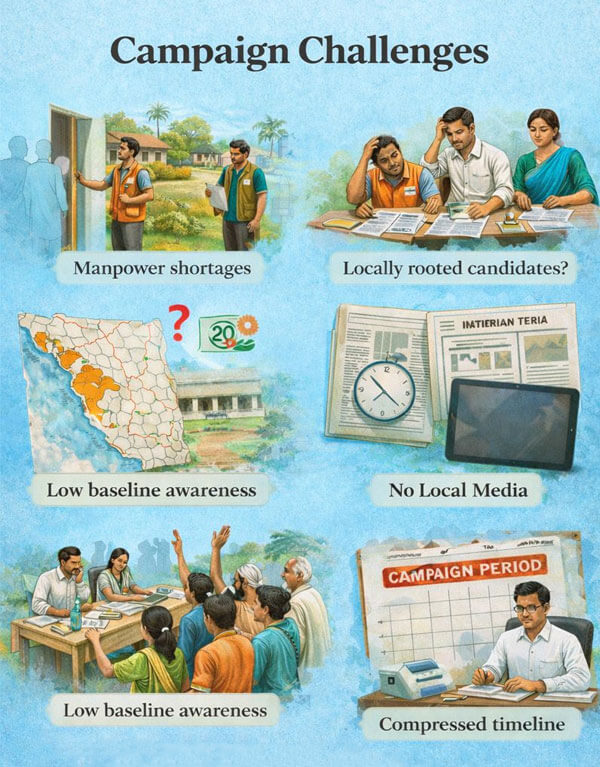
The campaign faced multiple structural and operational challenges:
- Manpower shortages for door-to-door canvassing
- Difficulty in identifying locally rooted candidates
- Low baseline awareness of Twenty20 outside its Ernakulam base
- A compressed campaign timeline
- Absence of an established local digital or media infrastructure
In a political environment dominated by entrenched alliances and well-organized party machinery, these constraints significantly reduced Twenty20’s ability to shape narratives, assess voter mood, and prioritize limited resources effectively.
Recognizing that traditional campaign methods alone would be insufficient, the local leadership identified a critical need for a digital-first, data-driven approach—one that could amplify reach, decode public sentiment in near real time, and compensate for organizational limitations.
The core problem, therefore, was not merely electoral competition, but how a resource-constrained, non-traditional political party could understand voter sentiment, build relevance, and make informed strategic decisions while expanding into a politically unfamiliar territory.
Data Sources & Coverage
The analysis focused on digital public discourse and engagement patterns related to the Twenty20 Party in Kanjirapally Grama Panchayat during the 30-day campaign period preceding the 2025 Kerala Local Body Elections.
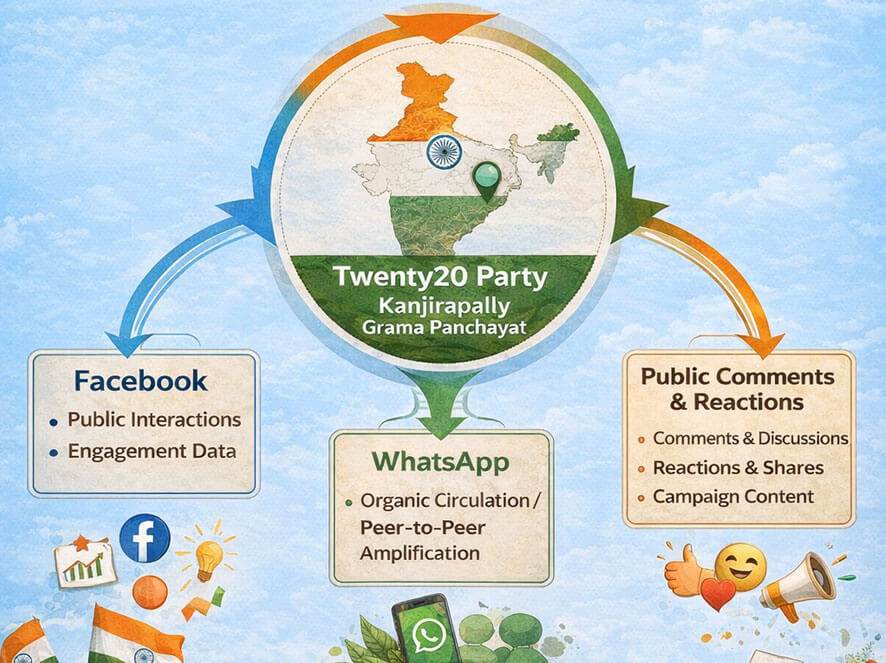
Primary data sources included:
- Public interactions and engagement data from Facebook
- Organic circulation and peer-to-peer amplification via WhatsApp
- Public comments, reactions, shares, and discussion threads linked to campaign-related content
The coverage spanned all 16 wards where Twenty20 fielded candidates, with particular emphasis on wards where physical campaign reach was limited.
Campaign Objectives Identified by Semiotica.ai
Based on the party’s expansion goals and ground realities, the following outcome-driven objectives were defined prior to execution:
- Create awareness about Twenty20 among first-time voters in Kanjirapally
- Build visibility and recall for the party and its local candidates
- Communicate Twenty20’s development-oriented ideology and governance model
- Build a ward-wise vote base, especially in areas with limited physical outreach
- Leverage the strong social media presence of central leadership—particularly Sabu M. Jacob, to reinforce credibility and trust
Key Constraints
The campaign was executed under multiple structural and operational limitations:
Limited timeframe:
30 days
Budgetary constraints:
Typical of a new political entrant
No pre-existing official digital assets for Twenty20 in the Kanjirapally geography
These constraints necessitated a high-efficiency, digital-first strategy with rapid feedback loops
Strategic Approach
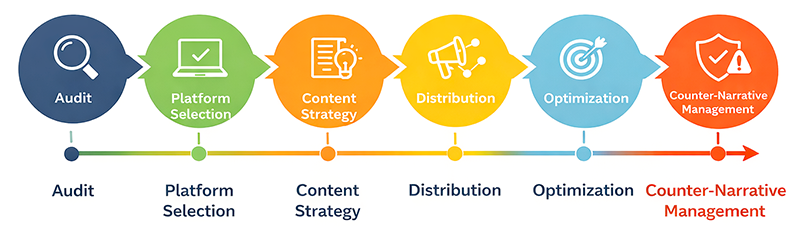
1. Digital Presence & Sentiment Audit
An initial audit of digital mentions and social media activity revealed a critical reputational risk.
Two large, non-official Facebook fan pages titled “Twenty20 Fans Kanjirapally” already existed. These pages were not controlled by party officials and were subtly circulating opponent-aligned (NDA) propaganda while retaining the Twenty20 identity. This exploited digital illiteracy common in tier-2 towns and posed a serious narrative hijack risk, as voters were unable to clearly distinguish between official and fake digital identities.
2. Platform Viability Analysis
A ward-level assessment of digital platform relevance and voter behaviour revealed clear differences in effectiveness across channels. X (Twitter) demonstrated negligible reach and limited impact within the local electoral context, while Instagram showed only modest penetration among the active voter demographic. LinkedIn was found to have minimal relevance for grassroots political communication, and YouTube, although influential, was assessed as high-effort, time-intensive, and budget-heavy—making it impractical given campaign constraints.
Based on considerations of reach, ease of execution, and financial viability, the campaign prioritised Facebook as the primary communication platform, supported by WhatsApp as a secondary channel for amplification and peer-to-peer dissemination.
Solution & Execution: Building Credibility Through Digital-First Political Communication
Establishing a Trusted Digital Identity
The first and most critical step was reclaiming narrative ownership. Semiotica launched the official Facebook page, “Twenty20 Kanjirapally,” establishing a single, verified source of communication for voters in the constituency.
All campaign communications were anchored around three non-negotiable principles: authenticity, consistent Twenty20 branding, and strict alignment with the tone and messaging of the central leadership. This immediately addressed voter confusion caused by unofficial pages and helped rebuild trust in the party’s digital presence.
Reviving and Activating the Supporter Base
With limited time and manpower on the ground, Semiotica focused on activating existing social capital. Supporters were mobilized through existing party WhatsApp groups and local volunteer networks, many of which had remained dormant prior to the campaign.
This activation not only revived internal engagement but also transformed supporters into message carriers, significantly improving organic reach and internal coordination.
Development-Centric Storytelling with Local Relevance
Rather than relying on generic political messaging, the campaign adopted a development-first narrative, grounded in real, everyday issues faced by voters in Kanjirapally. Content highlighted long-standing governance gaps such as inadequate development over the past decade, deteriorating road infrastructure, drinking water leakages, neglected rivers, environmental degradation, and inefficient use of public funds.
Crucially, stories were crafted ward by ward, ensuring hyper-local relevance and emotional resonance. This localized framing allowed voters to see their lived realities reflected in the campaign narrative.
High-Impact, Low-Cost Content Formats
To maximize engagement within budget constraints, Semiotica deployed a mix of simple yet powerful content formats. Static posts and multi-image carousels were used to present clear issue narratives, while short, issue-focused reels visually documented infrastructure neglect, water distribution failures, and road damage.
Candidate-centric videos—including problem-statement explainers, introductions, and recommendation clips, helped humanize the campaign and build personal connections with voters. High-quality development content from central leadership, other Twenty20 panchayats, and individual supporters and local influencers was selectively cross-posted to reinforce credibility and continuity.
Strategic Content Deployment and Amplification
Content was pushed aggressively on Facebook, the campaign’s primary platform, and then circulated organically through WhatsApp groups, enabling rapid peer-to-peer sharing and discussion. This two-layer distribution model significantly amplified reach beyond the immediate follower base and helped sustain momentum throughout the campaign period.
Performance-Led Paid Promotion and Optimisation
Despite tight budgets, the campaign invested in daily low-cost paid promotions to ensure consistent visibility. Continuous A/B testing was conducted to refine creatives and messaging in real time. High-performing content was repurposed into reels and recirculated, allowing the campaign to compound reach and engagement without increasing spend.
Measured Counter-Narrative Management
As visibility increased, opponent cyber groups responded with counter-posts, misinformation, and at times obscene or abusive language. Instead of reacting impulsively, Semiotica implemented a measured, issue-focused counter-communication strategy. Personal attacks were avoided, and responses consistently reinforced credibility, restraint, and governance-oriented messaging, strengthening voter trust rather than diluting it.
Outcome
Through disciplined digital execution, strategic storytelling, and controlled narrative management, Semiotica helped Twenty20 establish credibility, visibility, and voter engagement in a politically unfamiliar geography. The campaign demonstrated how data-informed, digital-first political communication can effectively compensate for structural and resource constraints faced by new political entrants.
Performance Metrics & Campaign Impact
Reach, Growth & Visibility
Within a tightly constrained 30-day campaign window, the digital-first strategy delivered rapid visibility and sustained audience growth despite the absence of any pre-existing official digital presence in the geography.
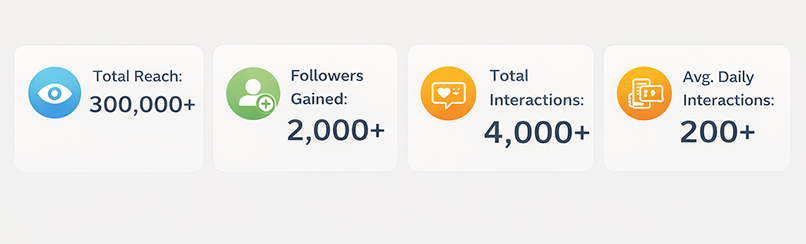
These outcomes are particularly significant given the campaign’s first-time entry into the district and limited on-ground infrastructure.
Engagement Quality & Audience Behaviour
Engagement patterns were driven primarily by positive, low-friction interactions, indicating strong content resonance and message acceptance.
- Reactions: 87.2%
- Comments: 6.9%
- Shares: 6%
Notably, over 90% of content consumption came from non-followers, highlighting strong algorithmic distribution and reach beyond the immediate supporter base. This is a critical indicator of message penetration among undecided voters and first-time audiences, rather than reliance on an existing core following.
90%+ of content consumption came from non-followers, indicating strong algorithmic penetration and content virality.
Audience Demographic Profile (Age)
The campaign achieved deepest traction among older, high-turnout voter segments, aligning with local election participation patterns:
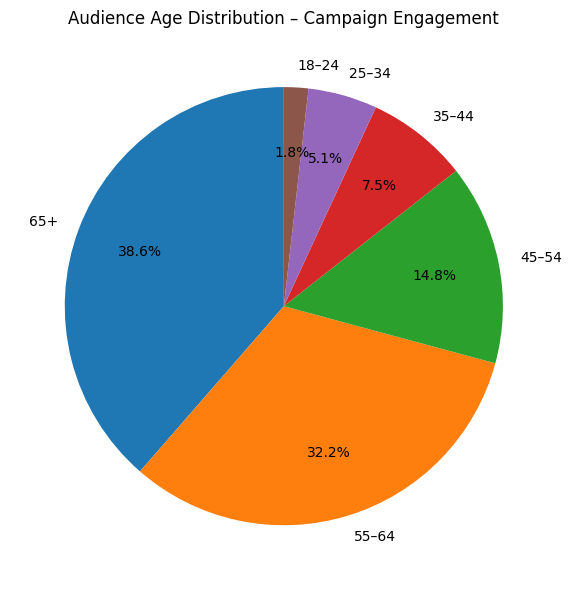
This distribution confirms that Facebook-based political communication remains highly effective among decision-making and turnout-reliable voter groups in grama panchayat elections.
Electoral Outcome & On-Ground Impact
The digital-first campaign translated visibility and engagement into measurable electoral traction across Kanjirapally Grama Panchayat.
- 1,500+ votes secured across 16 wards
- Second position achieved in one ward
- 150–200 votes secured in 3+ wards, where typical winning margins range between 350–450 votes, depending on ward size
While no seat was won, the results clearly demonstrate that Twenty20 was able to convert first-time voter engagement into meaningful vote share in a politically unfamiliar district—establishing a credible base for future electoral contests.
Key Takeaways, Strategic Impact & Learnings
The Twenty20 campaign in Kanjirapally demonstrated that electoral relevance can be built even in politically unfamiliar geographies, provided narrative control and digital execution are approached strategically. Despite structural and organizational constraints, including limited manpower, time, and physical outreach, Twenty20 emerged as a visible disruptor across multiple wards, successfully inserting itself into local political conversations dominated by established players.
A critical strategic outcome of the campaign was the establishment of Twenty20 as a credible political alternative in a district where the party had no prior electoral footprint. Through consistent messaging, official digital identity, and development-focused communication, the campaign was able to build a first-time vote base in a new district, converting awareness into measurable voter support.
The case also reinforced the continued dominance of Facebook as the most cost-effective digital platform for grama panchayat–level elections. Its reach among high-turnout voter segments, combined with algorithmic amplification, enabled rapid visibility and engagement within a short campaign window.
Equally important was the lesson around narrative ownership. The presence of fake or unofficial pages highlighted how unmanaged digital spaces can distort voter perception and undermine credibility. Reclaiming narrative control proved essential to restoring trust and ensuring message clarity.
Crucially, the campaign demonstrated that low-cost, digital-first political communication can translate visibility into votes. Through disciplined, development-centric storytelling rooted in local issues, the campaign shaped public discourse, sustained engagement, and delivered tangible electoral traction despite minimal budgets.
While the campaign did not result in immediate seat wins, it successfully laid the foundation for future electoral success by establishing recognition, credibility, and an engaged voter base—validating digital-first strategy as a long-term political asset rather than a short-term tactical tool for emerging and non-traditional political movements.