
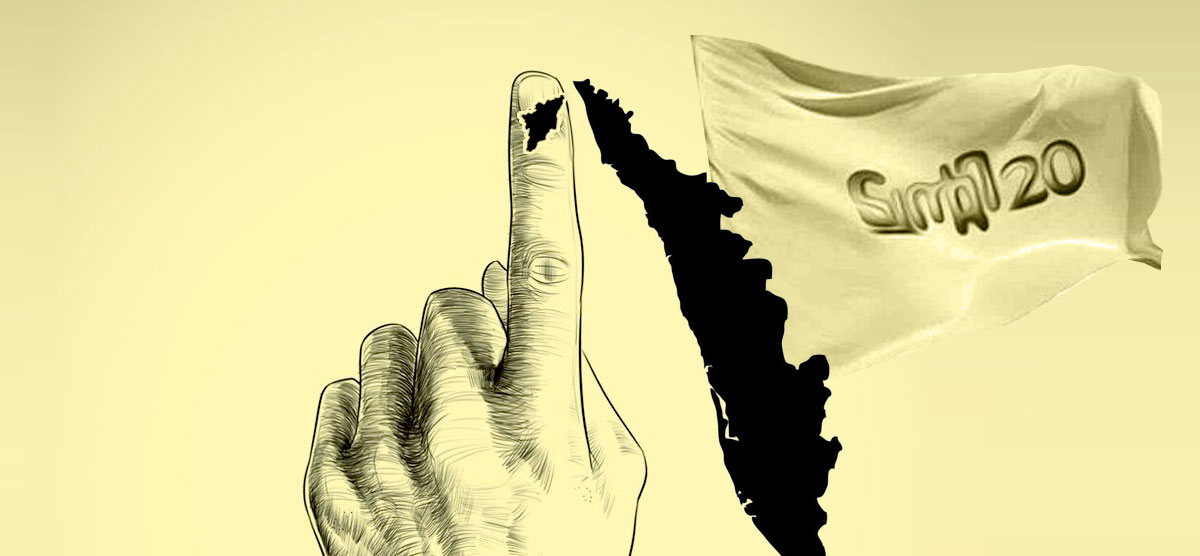
Kerala’s recently concluded local body elections have delivered a decisive message. The United Democratic Front (UDF) has emerged with renewed momentum across panchayats, municipalities, and corporations, converting anti-incumbency sentiment against the Left Democratic Front (LDF) into tangible electoral gains. For the Congress-led alliance, the verdict offers both relief and confidence as the state heads toward the 2026 Legislative Assembly election.
But for non-traditional political formations like Twenty20, the moment calls not for celebration or confrontation, but for strategic restraint. In a political culture that often equates visibility with relevance, restraint may seem counterintuitive. Yet, in Kerala’s current context, it may be Twenty20’s most valuable asset.
Local Body Elections Show Momentum, Not Structural Resolution
Local body elections in Kerala are best understood as proximity elections. Voters respond to familiarity, accessibility, and ward-level problem-solving more than long-term leadership vision or state-level policy coherence. The UDF’s strong performance reflects the advantages of opposition politics, dissatisfaction with the incumbent government’s local governance record and to a certain extent effective grassroots mobilization.
However, these results do not automatically resolve deeper structural challenges within Kerala’s political ecosystem.Ideological fragmentation within the Indian Union Muslim League and the deeply fractured Kerala Congress, along with aging leadership, succession uncertainty, and weak internal coordination, have increasingly distanced sections of the electorate, even as these parties retain their traditional organizational presence. These are leadership and organizational issues that local body victories alone cannot fix.
In short, the verdict represents momentum, not closure.

Why the Space for Disruption Has Narrowed
When voters decisively consolidate behind a major alliance, the tolerance for political disruption narrows sharply. Smaller formations entering such a landscape face an immediate risk of being framed as opportunistic or worse, as vote splitters. Notably, the UDF’s deployment of the “vote-splitter” narrative against Twenty20 candidates in the recent local body elections proved effective in consolidating its base wherever Twenty20 candidates contested, improving vote-share efficiency, and strengthening performance in closely contested wards amid broader anti-incumbency sentiment.
This dynamic carries significant implications for Twenty20. Unlike traditional parties, Twenty20’s appeal has been built on visible governance outcomes, administrative efficiency, and civic trust. Its success has stemmed precisely from positioning itself outside ideological confrontation and coalition arithmetic. A sudden or aggressive push into Assembly politics risks undermining that carefully cultivated positioning. In the current environment, rapid expansion is likely to be perceived less as strategic ambition and more as disruptive overreach, potentially weakening the trust and credibility that underpin Twenty20’s distinct appeal.
Why 2026 Should Be a Positioning Election, Not a Power Contest
Assembly elections are fundamentally different from local polls. They are about representation, leadership trust, and the ability to articulate a credible long-term vision for the state. For a governance-first movement like Twenty20, this distinction is critical.
The most rational path ahead of the 2026 Assembly election is not formal seat-sharing with any political front, nor a statewide contest. Instead, Twenty20 should treat 2026 as a positioning election rather than a power contest.
That means contesting selectively, perhaps five to eight constituencies at most; only in areas where it already enjoys civic legitimacy and where voter expectations around governance are high. It also means maintaining strategic ambiguity: avoiding pre-election alliances, ideological commitments, or coalition signalling that could compromise neutrality.
Most importantly, Twenty20 should signal post-election responsibility rather than pre-election alignment. In Kerala’s political culture, maturity is conveyed less through declarations and more through conduct. Restraint communicates seriousness.
The Underrated Power of Waiting
What if Twenty20 chooses patience?
If it contests selectively, wins even one to three Assembly seats on its own, and maintains its governance-first credibility, the post-election landscape changes dramatically. At that point, it ceases to be an outsider seeking relevance and becomes a stakeholder others must reckon with.
Crucially, any conversations between Twenty20 and political parties, if any, would take place after the election, when leverage is determined by results, not promises.
This is a far stronger negotiating position than entering the election as a junior partner in a seat-sharing arrangement. Pre-election alliances often solve short-term entry problems but almost always impose long-term identity costs, especially for movements that derive strength from being different.
Independence Is Not Isolation
There is a tendency in Kerala politics to treat independence as irrelevance. History suggests the opposite. Political capital in the state is often built incrementally, across cycles, through credibility rather than scale.
A small but credible Assembly presence can carry disproportionate influence—shaping debates, influencing policy priorities, and altering alliance arithmetic over time. What matters is not how many seats are contested, but how convincingly they are won.
For Twenty20, the equation is straightforward: independence combined with restraint today creates leverage tomorrow.
Restraint as Political Maturity
In Indian politics, restraint is frequently mistaken for hesitation. In reality, it is often a sign of institutional self-awareness. Knowing when not to expand is as important as knowing where to grow.
The expectations placed on the UDF after its local body success will be high. If governance delivery, leadership coordination, or candidate quality falls short, dissatisfaction will return, possibly sharper than before. When that happens, the space for credible alternatives will reopen. The question is not whether such moments will arise, but who will be ready for them. For Twenty20, readiness does not come from overreach. It comes from discipline.
A Long View of Relevance
The 2026 Kerala Assembly election is not Twenty20’s moment to seize power. It is its opportunity to earn space; carefully, credibly, and sustainably.
By resisting premature alliances, avoiding over-expansion, and respecting the current political mood, Twenty20 protects its most valuable asset: trust. In a political system where expectations rise faster than institutions can deliver, trust is rare and powerful.
Sometimes, the smartest political move is not to rush forward, but to stand still while others reveal their limits.
For Twenty20, restraint today may well be the foundation of relevance tomorrow.
About the Author
Jacob M George is the Co-founder and Board Director of semiotica.ai, a technology-driven political and deep-branding venture. Semiotica.ai combines AI, sentiment intelligence, and narrative analysis to help political parties and global brands decode public perception and design winning communication and growth strategies. Jacob’s work sits at the intersection of technology, public sentiment, and strategic communication, with a strong focus on building globally relevant platforms from India.
He is also the Co-founder & CEO of cmercury, an award-winning email marketing platform built from India for global markets. cmercury is currently used by email marketers across nearly 50 countries, helping businesses achieve high deliverability, efficiency, and scale through fair, usage-based pricing.
Add a Comment